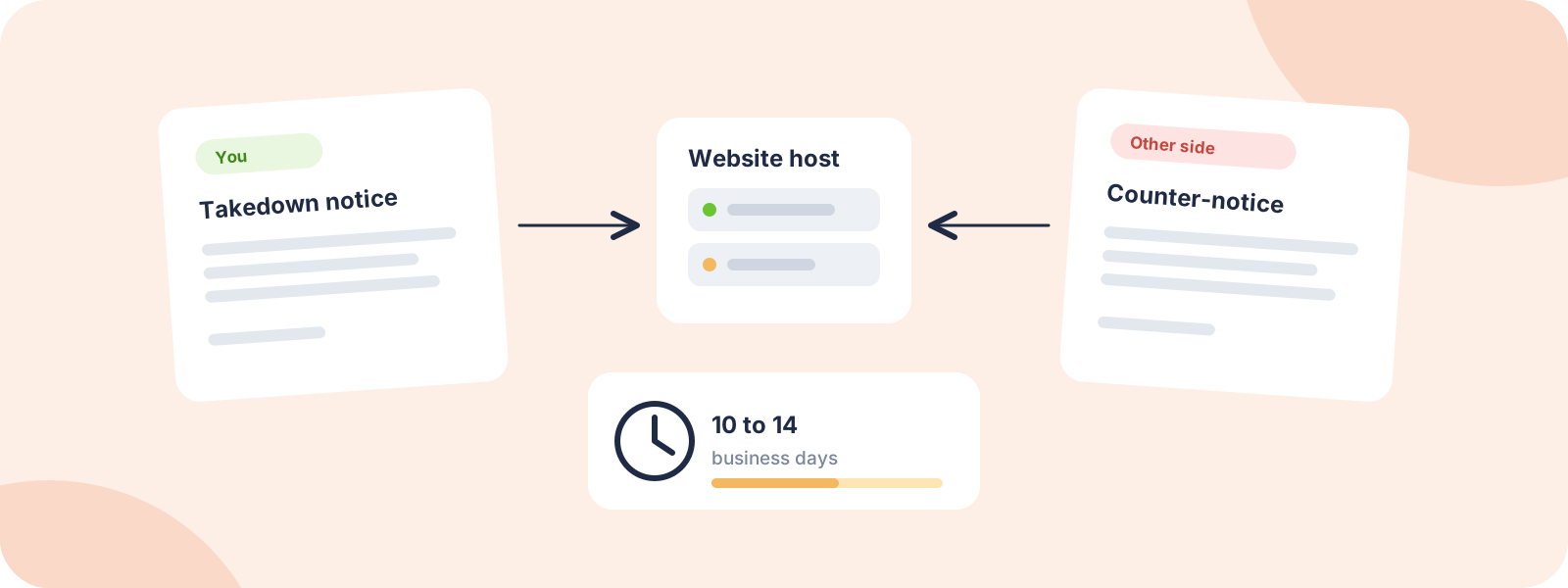
What a counter-notice is
When a website removes content after a DMCA takedown notice, the person who posted it gets a chance to push back. That pushback is a counter-notice. It's a formal statement that the content was removed by mistake or misidentified, for example because they own it, have a license or believe it's fair use.
The counter-notice goes to the website or platform, which passes it on to whoever sent the original takedown.
New to counter-notices? Our FAQ What is a DMCA counter-notice? covers the basics.
DMCA.com is not a law firm, and this guide isn't legal advice. If a counter-notice could lead to a lawsuit, talk to a copyright lawyer.
How the timeline works
- The takedown. The site removes the content after a valid notice.
- The counter-notice. The uploader sends one. The site forwards a copy to the person who sent the takedown.
- The waiting period. The site can put the content back no sooner than 10 and no later than 14 business days after it gets the counter-notice.
- The decision. If the person who sent the takedown tells the site they've filed a court action to stop the infringement, the content stays down. If not, it can go back up.
That's US law for service providers that follow the DMCA process. Platforms outside the US, and big platforms with their own systems, may handle disputes differently.
If you sent the takedown
Getting a counter-notice is frustrating, but it doesn't mean you were wrong. It means the other side disagrees. Here's what to do:
1. Read it carefully
Check it's complete (see what a valid counter-notice includes). Note the date the site received it, because the 10 to 14 business day clock starts there.
2. Look at their reason honestly
Do they claim a license, permission or fair use? Did you give permission once, or sell the work to someone? If their reason holds up, it may be better to let it go. If you're not sure, our guide on fair use can help you think it through.
3. Decide quickly
The only way to keep the content down is to file a court action and tell the site before the window closes. That's a big step, so talk to a copyright lawyer as soon as you can. In the US, you generally need a copyright registration (or a refused application) before you can file a copyright lawsuit.
4. Keep other options open
- If the content goes back up, removing the page from Google search may still be possible where the claim is valid. It's part of our Platinum Takedown ($599 per site). See removing a webpage from Google.
- If the counter-notice looks fake, with a made-up name or address, tell the site. A counter-notice has to include real contact details.
If your content was taken down
If something you posted was removed after a takedown, you have a few options:
- Accept it. If you used someone else's work without permission, the simplest fix is to leave it down and replace it with something you own or license.
- Contact the person who sent the notice. If it's a misunderstanding, like a license they forgot about, they can withdraw the claim.
- File a counter-notice. Only if you honestly believe the removal was a mistake or a misidentification.
A counter-notice is a sworn statement. You give your real name and address, which the other side receives, and you agree that they can sue you in court. A false counter-notice can make you liable for damages. If you're unsure, get legal advice first.
What a valid counter-notice includes
Under US law, a counter-notice needs all of these:
- A physical or electronic signature.
- What was removed and where it appeared before it was removed.
- A statement, under penalty of perjury, of a good faith belief that it was removed by mistake or misidentification.
- The uploader's name, address and phone number.
- Consent to the jurisdiction of a US federal court (for their district, or a court where the service provider can be found if they're outside the US).
- Agreement to accept legal papers from the person who sent the takedown.
If one of these is missing, the site doesn't have to treat it as a valid counter-notice.
How DMCA.com can help
Two ways to get it done: have our team handle it, or send notices yourself with our tools.
We handle the takedown side: writing and sending notices, following up with sites and hosts, and getting pages out of Google. We don't give legal advice or represent anyone in court.
- Counter-claim review and response handling is part of our Platinum Takedown ($599 per site)
- Standard takedowns are $199 per site, with a money-back guarantee on qualifying cases
- Sites that ignore notices are covered by our Premium Takedown ($399 per site), and Google search removal is part of our Platinum Takedown ($599 per site)
- Rather send notices yourself? Protection Pro ($10 a month) includes the DIY Takedown Toolkit: notice templates and host lookup tools
Common questions
How long until content goes back up after a counter-notice?
Under US law, a service provider can restore it no sooner than 10 and no later than 14 business days after receiving a valid counter-notice, unless it's told a court action has been filed.
How do I stop the content going back up?
File a court action to stop the infringement and tell the service provider before the window closes. Talk to a copyright lawyer, because this means going to court.
Will the other side see my details?
Yes. A counter-notice includes the uploader's name, address and phone number, and the website forwards it to the person who sent the takedown.
Can I get in trouble for a counter-notice?
Yes, if it's false. A counter-notice is made under penalty of perjury, and knowingly misrepresenting that content was removed by mistake can make you liable for damages.
Does DMCA.com file lawsuits?
No. DMCA.com is a takedown and content protection service, not a law firm. If you need to go to court, talk to a copyright lawyer.
JL
About the author
Julie Lyle is the Takedown Manager at DMCA.com, where she oversees professionally managed takedown cases, from copyright removals to Google search removals. More about Julie