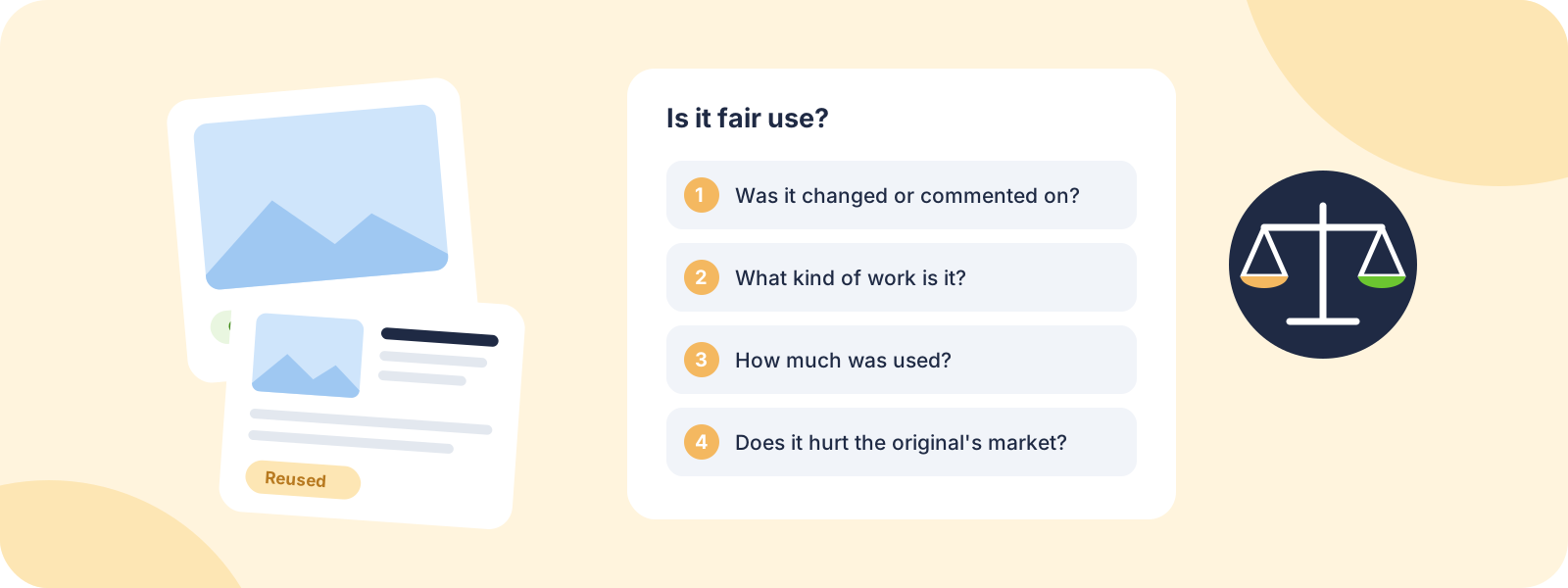
What fair use is
Copyright gives you control over how your work is copied and shared. Fair use is the exception. It lets other people use parts of your work without asking, for purposes like commentary, criticism, news reporting, teaching, research and parody.
There's no checklist that makes something automatically fair use. If it's ever disputed, a court decides by weighing four factors. That's why fair use is a judgment call, not a yes-or-no rule.
This guide is general information, not legal advice. DMCA.com is not a law firm. For a fair use dispute that might go to court, talk to a copyright lawyer.
The four factors, in plain English
1. Why and how they used it
Did they add something new, like commentary, criticism or a different purpose? Or did they just repost your work? Uses that transform the original weigh toward fair use. Commercial use doesn't rule it out, but it counts against it.
2. What kind of work it is
Creative work, like photos, art, music and fiction, gets more protection than factual work, like news facts or data.
3. How much they took
A short clip or quote to make a point leans toward fair use. Your whole photo, video or article leans against it. Taking the most important part, even if it's small, can also count against it.
4. Whether it hurts your market
If their use replaces yours, so people get your work from them instead of you or your licensing loses value, that weighs heavily against fair use.
Usually fair use vs usually not
Often fair use
- A reviewer shows short clips of your video while critiquing it.
- A news story quotes a few lines from your post.
- A parody that comments on your work by imitating it.
- A teacher uses a small excerpt in class to explain a point.
Usually not fair use
- Your full photo reposted on someone else's site or account.
- Your whole video re-uploaded, even with a "no copyright intended" note.
- Your product photos used to sell someone else's products.
- Your articles copied onto another blog to earn ad money.
Fair use myths
- "I gave credit, so it's fine." Credit is polite, but it doesn't make a copy fair use.
- "I'm not making money from it." Non-commercial use can still infringe.
- "No copyright infringement intended." A disclaimer doesn't change anything.
- "It was on the internet, so it's public." Being online doesn't put work in the public domain.
- "I only used a few seconds." There's no safe number of seconds or words. It depends on all four factors.
Should you still file?
In the US, you're expected to consider fair use before you send a takedown notice. That doesn't mean you need to be certain. It means you've looked at the use and honestly believe it isn't allowed.
- A straight copy of your work? File. This is what takedowns are for. Start with how to file a DMCA takedown notice.
- Commentary or criticism that uses a small part? Think carefully. If it's a review you don't like, a takedown is likely to be challenged.
- Somewhere in between? You can file, but be ready for a counter-notice.
Using takedowns to silence criticism tends to backfire. It can draw far more attention to the content. Read about the Streisand effect.
Outside the US
Fair use is a US idea. Countries like the UK, Canada and Australia have a narrower rule called fair dealing, which only covers specific purposes, like criticism, review, news reporting, research and, in some countries, parody. If the site or uploader is outside the US, local rules can change the answer. For Europe, see takedowns in Europe.
How DMCA.com can help
Prefer to hand it off? Here's how our team can take this on for you.
Not sure whether a use crosses the line? Send us the links for a free case review. A real person looks at your case and gives you an honest assessment of whether a takedown is likely to succeed. You pay nothing until you're ready to go ahead. We don't give legal advice.
- Standard takedowns are $199 per site, with a money-back guarantee on qualifying cases
- Sites that ignore notices are covered by our Premium Takedown ($399 per site), and Google search removal is part of our Platinum Takedown ($599 per site)
- Rather send notices yourself? Protection Pro ($10 a month) includes the DIY Takedown Toolkit: notice templates and host lookup tools
Common questions
Is it fair use if they gave me credit?
Not by itself. Giving credit doesn't turn a copy into fair use.
Is non-commercial use always fair use?
No. Non-commercial use can still infringe, especially if someone copies your whole work.
How many seconds of a song or video can someone use?
There's no safe number. Fair use depends on why it was used, what was used, how much and the effect on your market, not a set number of seconds.
Do I have to consider fair use before filing a takedown?
In the US, yes. You should honestly consider whether the use could be fair use before sending a takedown notice.
More quick answers in our FAQ: What is fair use? and What is a DMCA counter-notice?, which covers what happens if they claim fair use after your takedown.
JL
About the author
Julie Lyle is the Takedown Manager at DMCA.com, where she oversees professionally managed takedown cases, from copyright removals to Google search removals. More about Julie