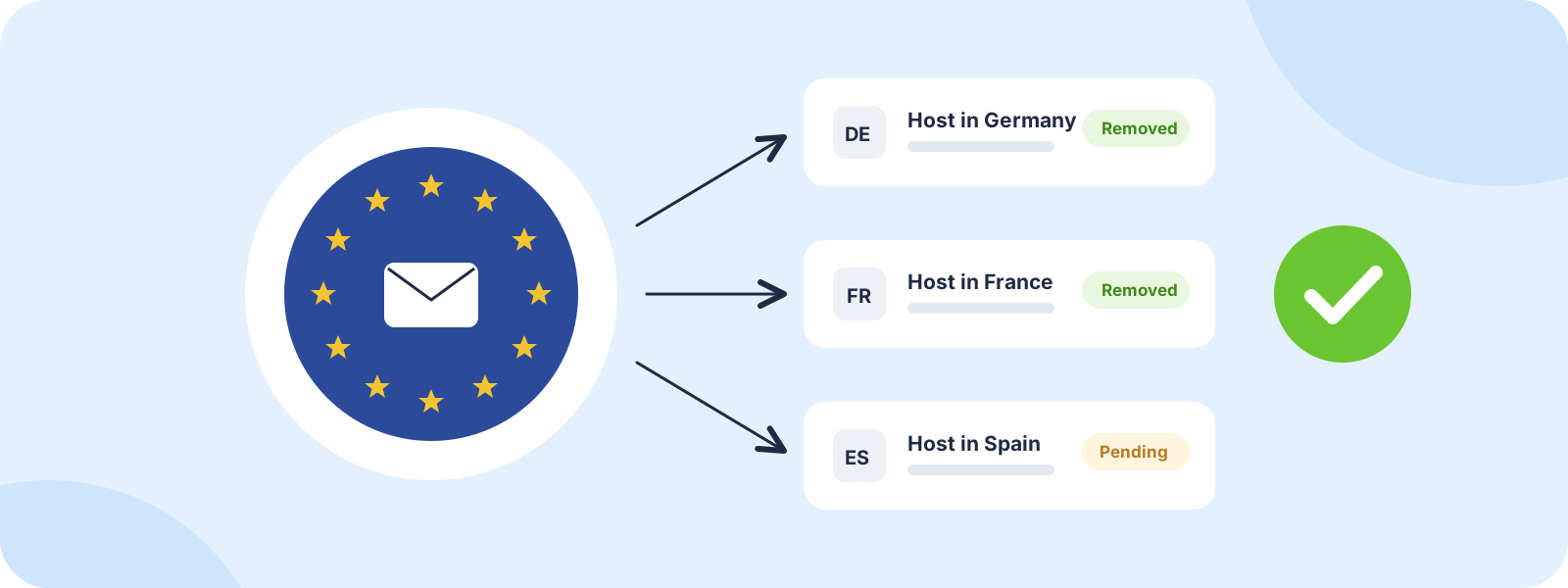
Which rules apply
In the EU, the main rulebook for online content is the Digital Services Act (DSA). It applies to services offered to people in the EU, including websites, hosting companies and online platforms, wherever the company is based.
Under the DSA, hosting services have to give people an easy, online way to report illegal content. Content that infringes your copyright counts. Once they get a proper notice, they're expected to look at it and act on it in a timely, careful way.
Copyright itself is still set by each country's own law, which is based on shared EU rules. For most takedowns you don't need to know the details. You need a clear notice sent to the right place.
This guide is general information, not legal advice. DMCA.com is not a law firm.
Step 1: Find out where the site is
Which rules apply depends on where the site and its host are, so this comes first. It's also where many cases stall. A European site can be run from one country, hosted in another and hidden behind a service like Cloudflare, so the real host isn't obvious. See sites that use Cloudflare.
Step 2: What your notice must include
Under the DSA, a notice should include:
- Why the content is illegal. For copyright, say what your work is, that you created and own it, and that you didn't give permission.
- The exact location. The precise URL of each copy, not the homepage.
- Your name and email address.
- A good-faith statement that the information in your notice is accurate and complete.
Many European hosts also accept a standard DMCA notice, but one written for EU rules reads more naturally to them. Getting every detail right matters: a notice that points to a homepage instead of each copy, or misses a required statement, can be set aside. Notice templates for the EU (including the UK) are part of the DIY Takedown Toolkit in Protection Pro.
Step 3: Who receives it
Depending on the case, an EU notice goes to the platform, the site owner or the hosting company. Under the DSA, hosting services have to provide a way to report illegal content, but each one runs its own process.
This is where cross-border cases get stuck: contact details that are buried or missing, reporting systems that differ from host to host, and smaller sites that don't reply. Most European hosts handle reports in English, so language is rarely the problem. Finding the right contact usually is.
Step 4: What happens next
- Confirmation. Hosts using an online reporting system should confirm they've received your notice and tell you what they decided.
- The uploader is told why. If content is removed, the uploader gets an explanation and, on platforms, a way to challenge it. This is the EU's version of a counter-notice.
- No response? This is where many cross-border cases stall. Hosts in other countries can be slow, and every follow-up needs a complete notice.
- Still up? Google can remove some pages from search results while the site itself is dealt with. See removing a webpage from Google.
The UK, Switzerland and others
The UK and Switzerland aren't in the EU, so the DSA doesn't apply to sites based there. Hosts in both still remove infringing content when they get a clear, complete notice, because ignoring it can make them responsible too. The same notice works.
Canada is different. It uses a "notice and notice" system, where hosts forward your notice to the uploader instead of removing the content. You can still report directly to platforms, and Google search removal still works.
How DMCA.com can help
Prefer to hand it off? Here's how our team can take this on for you.
Do it yourself, with our tools
Protection Pro ($10 a month) includes the DIY Takedown Toolkit: notice templates for the US, Canada, the EU (including the UK) and India, and host lookup tools.
Have us do it for you
- We file notices with sites, hosts and platforms worldwide, including Europe
- We follow up with the site and the host until it's handled
- Standard takedowns are $199 per site, with a money-back guarantee on qualifying cases
- Sites that ignore notices are covered by our Premium Takedown ($399 per site), and Google search removal is part of our Platinum Takedown ($599 per site)
Common questions
Does the DMCA apply in Europe?
No. The DMCA is a US law. EU sites follow EU rules, mainly the Digital Services Act, though many European hosts still accept DMCA-style notices.
Can I file a copyright complaint in the EU if I live outside Europe?
Yes. You don't have to live in the EU to report content on an EU-based site or host.
What does an EU takedown notice need?
An explanation of why the content is illegal, the exact URL of each copy, your name and email address, and a statement that the information is accurate and complete.
Do I have to write my notice in the local language?
Usually not. Most European hosts and platforms handle reports in English.
What if a European site ignores my notice?
That's common with cross-border cases. They usually need follow-up and escalation, which our Premium Takedown covers, and Google search removal, which is part of our Platinum Takedown, can help in the meantime.
Does the same process work in the UK?
Mostly. The UK isn't covered by the Digital Services Act, but UK hosts generally remove infringing content after a clear, complete notice.
JL
About the author
Julie Lyle is the Takedown Manager at DMCA.com, where she oversees professionally managed takedown cases, from copyright removals to Google search removals. More about Julie