What Cloudflare does (and doesn't do)
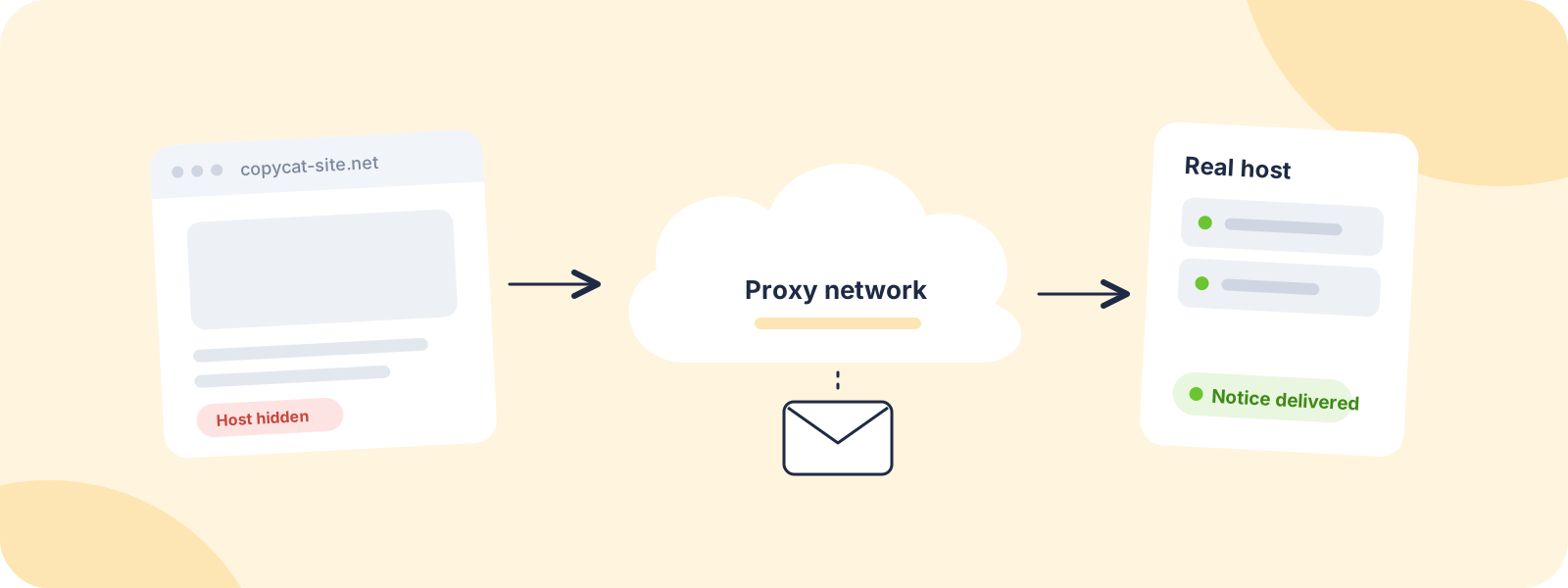
Cloudflare is a security and speed service that millions of websites use. When a site uses it, visitors connect to Cloudflare first, and Cloudflare fetches the page from the site's real server. That's why the site's hosting records show Cloudflare instead of the actual host.
For most sites, Cloudflare is just passing the content through. It doesn't store the site's files, so it can't delete your stolen photo or copied article from the server. What it can do is:
- Forward your complaint to the website owner.
- Forward it to the real hosting company.
- Tell you who that hosting company is, so you can contact them yourself.
That last one is the part that matters. Once you know the real host, you're back on the normal takedown path.
Check whether a site uses Cloudflare
A site's hosting and name server records show whether it sits behind Cloudflare. Reading them correctly matters, because it decides who your notice goes to. Get it wrong and the notice goes to a company that can't act on it.
Host lookup tools are part of the DIY Takedown Toolkit in Protection Pro ($10 a month), and our team does this research for you on a managed takedown. If the site isn't behind Cloudflare, our guide on getting content removed from another website explains what's involved.
What happens when you report through Cloudflare
Cloudflare accepts copyright reports. A report needs the same parts as any takedown notice: the exact URLs of the copies, your original, your details and the required statements. Our FAQ on how to file a DMCA takedown notice explains what a notice is.
For a site that only passes through Cloudflare, it then:
- Forwards your report to the site owner.
- Forwards it to the real hosting company.
- Usually tells you who that host is.
That's where Cloudflare's part ends. Getting the content removed still depends on the host acting on a complete notice of its own.
Heads up: Cloudflare may share your report, including your name and email, with the site owner and the host. If privacy matters, use a business email address. If you're dealing with intimate images, start with our nude photo removal guide instead.
Why these cases often stall
- Cloudflare only passes it on. A forwarded report isn't the same as the host acting on it.
- Hidden hosts are often hard to reach. Some sites use Cloudflare on purpose, with hosts in countries that rarely respond to copyright complaints.
- Sites can move without it showing. Because Cloudflare hides the server, a site can switch hosts and look exactly the same, and the case has to start again with the new host.
- Every step needs follow-up. Reports go unanswered, and each new contact needs its own complete notice.
- The page stays in Google until someone asks for it to be removed. See how removing a webpage from Google works.
If the whole site is built on copied content, see how to get a website taken down.
When Cloudflare is the host
Cloudflare also has products that do store files, like website hosting, file storage and video. If the content lives on one of those, Cloudflare is the host and can remove it itself. In that case Cloudflare acts on the report directly instead of passing it on.
How DMCA.com can help
Prefer to hand it off? Here's how our team can take this on for you.
Do it yourself, with our tools
Protection Pro ($10 a month) includes the DIY Takedown Toolkit: notice templates and host lookup tools, plus a dashboard to track every case.
Have us do it for you
- We find the real host behind Cloudflare and send the notice to the right contact
- Hidden or unresponsive hosts are covered by our Premium Takedown ($399 per site), with host research and escalation
- We follow up with the site and the host until it's handled
- Standard takedowns are $199 per site, with a money-back guarantee on qualifying cases
- Google search removal is part of our Platinum Takedown ($599 per site)
Common questions
Does Cloudflare host websites?
Usually not. For most sites, Cloudflare only passes traffic through to the real host. It does host content for some of its own products, like website hosting and file storage, and can remove that content itself.
Will Cloudflare remove the content?
For most sites, no. Cloudflare can't delete files it doesn't store. It forwards your report to the site owner and the host and tells you who the host is, so you can send your notice there.
Does it cost anything to report to Cloudflare?
Cloudflare doesn't charge for reports. The real cost is time: finding the real host, sending a second complete notice and following up. Our team handles that from $199 per site, or the DIY Takedown Toolkit in Protection Pro ($10 a month) gives you templates and host lookup tools.
Will the site owner see my report?
They may. Cloudflare can share your report, including your contact details, with the site owner and the host. Use a business email address if privacy matters.
Can Cloudflare tell me who owns the site?
Not usually. Cloudflare tells you who the host is, but it generally only shares the site owner's identity when legally required, such as with a court order.
What if the host is in a country that ignores DMCA notices?
Hard-to-reach hosts usually need more research and escalation, which is what our Premium Takedown covers. Removing the page from Google search results can help in the meantime, and that's part of our Platinum Takedown.
JL
About the author
Julie Lyle is the Takedown Manager at DMCA.com, where she oversees professionally managed takedown cases, from copyright removals to Google search removals. More about Julie