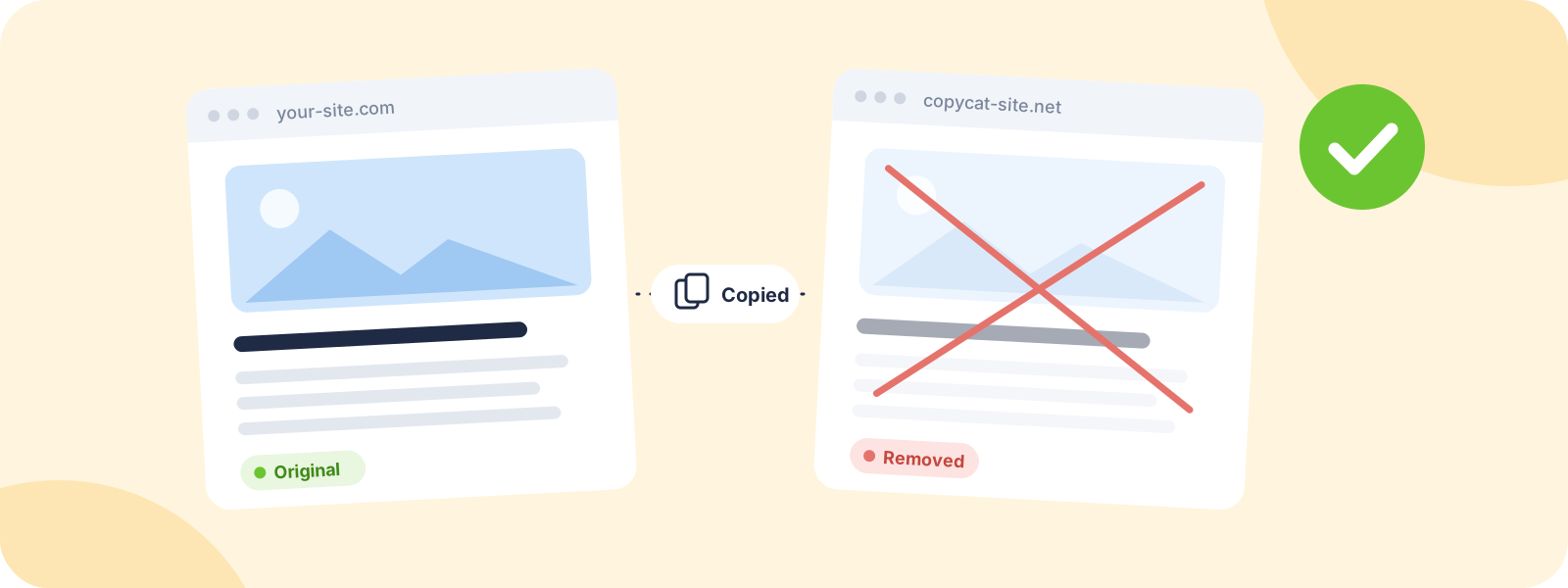
Step 1: Save proof
Before you contact anyone, capture what's there now. Sites sometimes change or hide content once they know you've noticed.
- Exact URLs of every page that uses your work.
- Screenshots with the URL and date visible.
- Proof it's yours, like the original file, earlier drafts or the date you first posted it.
Dated evidence that your page existed first, like older snapshots in the Internet Archive's Wayback Machine, helps when the copier claims the work is theirs.
Step 2: What kind of problem is it?
"Stolen content" covers a few different situations, and each one has its own removal route. Picking the right one first saves time.
- They copied your photos, videos, writing, art, designs or code. That's copyright. Keep reading. A DMCA takedown notice is usually the fastest fix.
- They're using your brand name or logo, for example to sell knock-offs or pretend to be you. That's trademark, which platforms handle separately from copyright. Our trademark vs copyright explainer covers the difference.
- They posted private photos or videos of you. Follow our guide to removing intimate images, or see personal takedowns.
- They posted your address, phone number or other personal details. See removing personal info from Google.
- They made a fake account pretending to be you. That's impersonation, which platforms also handle separately from copyright.
- They posted false claims about you. That's defamation. It usually needs a lawyer or a court order, not a takedown notice.
Step 3: Should you contact the site owner first?
You don't have to. A formal takedown works without warning anyone. A short, polite message can be the quickest fix when:
- It's a small business, blogger or creator who may not know they did anything wrong.
- You'd be happy with credit or a license fee instead of removal.
- The site has clear, real contact details.
Skip it when the site is anonymous, built on copied content, selling pirated material or has already ignored you. Contacting them can just give them time to move the content.
Step 4: Send a formal takedown
A DMCA takedown notice is a formal request that a site, platform or host remove content that copies your work. It includes a few specific statements, and most sites are set up to act on it.
This is where most people get stuck:
- Finding the right contact. Big platforms each run their own copyright process, and ordinary websites often bury or leave out their copyright contact.
- Getting every detail right. A notice that misses a required statement or the exact URLs can be rejected or ignored.
- Following up. Many sites don't reply the first time.
Our FAQ on how to file a DMCA takedown notice explains what a notice is and who receives it.
Step 5: Go to the hosting company
Every website lives on a server run by a hosting company. When the site itself ignores you, the host is the company that can still remove the content, and most hosts don't want legal trouble over a customer's content.
The hard part is working out who the real host is. Many sites hide it behind services like Cloudflare, and some hosts are overseas or slow to answer. See sites that use Cloudflare.
Step 6: Clean up search results
Copied content can show up in Google next to yours, and sometimes ranks above it. Even after the page comes down, an old result can linger for a while.
- If the page is still up and copies your work, Google can remove it from search results after a copyright request.
- If the page is gone but still shows in results, Google can refresh the outdated result.
Each has its own process and requirements. What Google can and can't do is covered in our guide on how to remove a webpage from Google search results.
Step 7: If it keeps happening
Popular content gets copied again and again. A few things help:
- Check regularly. Run a reverse image search on your best photos, and search a unique sentence from your writing in quotes. Our guide on using reverse image search shows how.
- Make protection visible. A DMCA.com protection badge shows visitors and would-be copiers that your content is protected and monitored.
- Use monitoring if checking by hand is too much. DMCA.com monitoring scans for copies of your content for you.
- Whole site copied? See what to do if your entire website has been copied.
How long does removal take?
It depends on the site, its host, where it's based and how complex the case is. In the cases our team handles, most come down within 24 to 48 hours, and the average is 5 to 10 business days. Rare cases can take a month or longer, especially with sites overseas or built to dodge requests. No one can honestly guarantee a time frame.
How DMCA.com can help
Prefer to hand it off? Here's how our team can take this on for you.
- Done for you: we write the notice, find the right contact, send it and follow up with the site and host until it's handled. Standard takedowns are $199 per site, with a money-back guarantee on qualifying cases.
- Bigger cases: many links or sites that ignore notices are covered by Premium ($399 per site), and Google search removal is part of Platinum ($599 per site).
- Do it yourself: Protection Pro ($10 a month) includes the DIY Takedown Toolkit: notice templates and host lookup tools.
Common questions
They gave me credit. Isn't that allowed?
Credit isn't the same as permission. Unless you agreed to the use, or it's a limited use like commentary or a short quote, giving credit doesn't make copying your work OK.
They only copied part of my article. Can I still get it removed?
Often, yes. Quoting a sentence or two with credit may count as fair use, but copying large sections usually doesn't. If you're unsure, a takedown service or a lawyer can look at the specific case.
Can I ask them to pay instead of removing it?
Yes. It's your work, so you can offer a license instead of asking for removal. Get any agreement in writing.
Do I need a watermark or copyright notice to be protected?
No. You own the copyright to work you create as soon as you create it. Watermarks and notices help deter copying and prove ownership, but they aren't required.
What if the website is outside the US?
You can still send a notice. Most large platforms accept copyright reports from anywhere, and many sites outside the US respond to them. Hosts in some countries can take longer.
Can I remove stolen content from social media the same way?
Yes, but each platform runs its own copyright process, and some use multi-step systems that are harder to get through. A takedown service can file it for you.
JL
About the author
Julie Lyle is the Takedown Manager at DMCA.com, where she oversees professionally managed takedown cases, from copyright removals to Google search removals. More about Julie