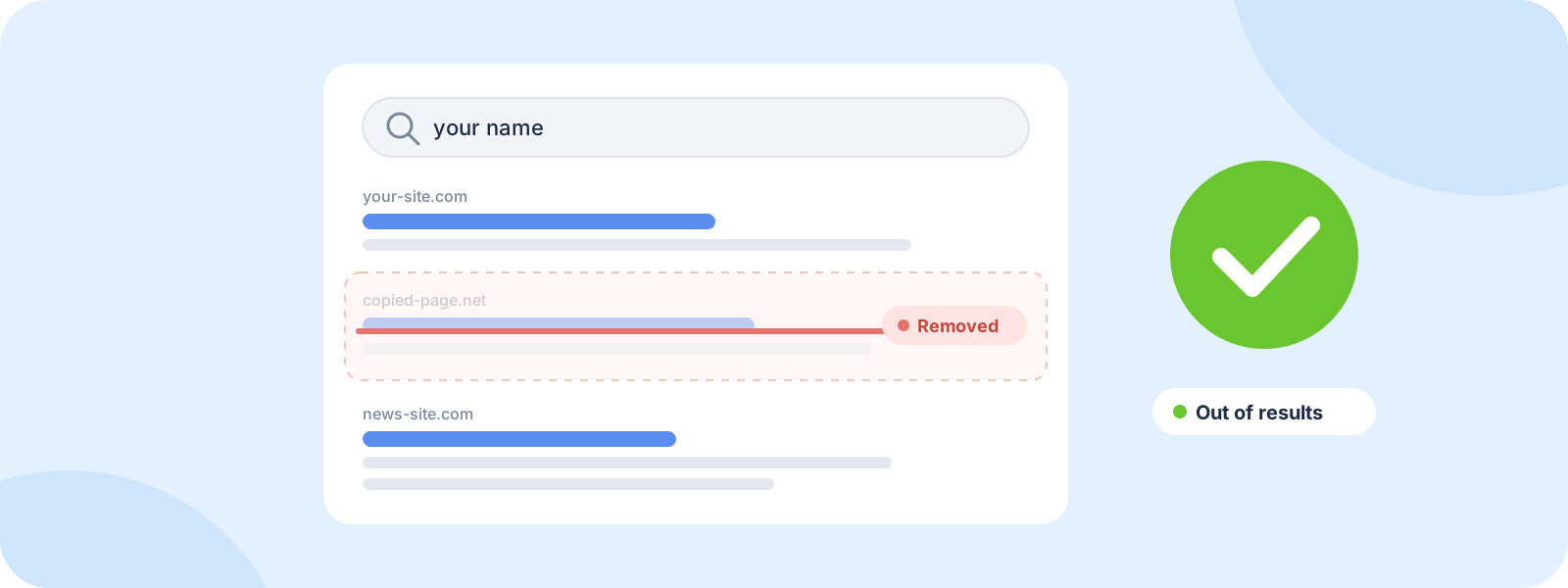
First: what Google removal does and doesn't do
Google controls its search results, not the internet. When Google removes a result:
- The page itself stays online. Anyone with the link, or who finds it another way, can still see it.
- Other search engines may keep showing it until you ask them to.
- It works best as part of a plan: get the page removed at the source and out of search results.
That said, most people find content through search. Getting a page out of Google, especially out of searches for your name or brand, means far fewer people will ever see it. That's why it's so useful when a site refuses to take something down.
To get content removed from the website itself, see our guide on getting stolen content removed from a website.
Route 1: The page is gone or has changed
Sometimes the site has already deleted the content, but Google still shows the old page, title or snippet because it hasn't checked the page again yet.
You can ask Google to recheck the page:
- It works when the page or image no longer exists, or has changed significantly from what Google shows.
- It won't remove a page that's still live and unchanged. For that, use one of the routes below.
This is the step people most often miss after a successful takedown. The content is gone, but the search result hangs around.
Route 2: The page copies your work
If a page uses your photos, videos, writing or other work without permission, Google can remove it from search results under copyright law, even if the site itself won't respond. It's the route that matters most when a site ignores takedown notices or is hosted somewhere that won't act.
Where it gets hard
- Google reviews every URL. Each copy has to be listed exactly and matched to your original, and incomplete requests are turned down.
- Copies multiply. Mirror sites, new pages and image results each need their own request.
- Results can come back. The site owner can file a counter-notice, and Google may then restore the result.
- Other search engines are separate. Bing and others have their own processes.
Good to know: Google shares copies of many copyright removal notices with Lumen, a public research database. The shared copy can include the sender's name or business name and the URLs reported. Personal contact details are removed. Where a result was removed, Google may show a note at the bottom of the search results linking to the notice.
How notices and counter-notices work is covered in our FAQ on filing DMCA takedown notices and our guide on counter-notices.
Route 3: The page shows your personal information
Google accepts requests to remove results that show:
- Your home address, phone number or email address
- Government ID numbers, like a Social Security number
- Bank account or credit card numbers
- Images of your signature or ID documents
- Private records, like medical records
- Login details, like usernames and passwords
- Personal information shared to threaten or harm you (doxxing)
Google can also alert you when new results with your contact details appear. Google may keep results it considers newsworthy or in the public interest, even if they include personal information.
Route 4: The page shows intimate images of you
Google has a dedicated request for removing intimate images shared without consent, including AI-made fakes. It also tries to find and remove duplicates of the same images.
For the full process, including getting the images removed from the sites themselves, see our guide on how to remove nude photos or videos from the internet.
Route 5: The page is on your own website
If you control the site, you have faster options:
- For a quick, temporary fix, Google lets site owners hide a page from search for a while as they change or remove it. No one can promise how fast Google acts. In the cases our team handles, most come down within 24 to 48 hours, and the average is 5 to 10 business days. Rare cases can take a month or longer.
- For a permanent fix, delete or update the page, put it behind a password, or add a "noindex" tag so Google stops showing it.
- Don't rely on robots.txt alone. Google advises against using it to hide pages from search.
Remember to cover every version of the URL, for example with and without "www."
Route 6: Everything else
Negative reviews, old news stories, unflattering blog posts and forum threads usually don't qualify for removal just because you don't like them. Your options are:
- Ask the website to remove or update the page. If it does, use Route 1 to refresh Google's result.
- Check the site's own rules. Review sites and forums often remove posts that break their policies, like fake reviews or harassment.
- Get legal advice for false and damaging claims. Google accepts some legal removal requests, which often go more smoothly with a court order. A lawyer can tell you what applies to you. DMCA.com is not a law firm.
- If you live in the EU or UK, data protection law can give you the right to ask Google to delist some results about you. Google has a separate form for these requests.
- Push it down. New, accurate content you control, like your own website and active social profiles, can outrank an old result over time.
What to expect after a request
- Review times vary. Google doesn't publish set times, and they differ by request type. Temporary removals on your own site are the quickest.
- Partial results are common. Google can approve some URLs in a request and turn down others.
- Removal isn't always final. A counter-notice can bring a copyright result back, and new copies need new requests.
- The page itself stays online until the website or its host removes it, so removal at the source still matters.
How DMCA.com can help
Prefer to hand it off? Here's how our team can take this on for you.
Google search removal is part of our Platinum Takedown, for cases where a standard notice to the site isn't enough.
- Platinum Takedowns, which include Google search removal, are $599 per site
- Standard takedowns, for getting content removed from one site, are $199 per site
- A real person reviews your case and tells you which option fits before you pay anything extra
- When we file the Google request, DMCA.com is named as the sender in the public Lumen record, not you
- Prefer to send notices to the site yourself? Protection Pro ($10 a month) includes the DIY Takedown Toolkit: notice templates and host lookup tools
Common questions
Can I remove a Google search result myself?
You can send Google a request yourself. Where people get stuck is building a request Google will accept, listing every URL correctly and following it through when the site won't act. Our Platinum Takedown ($599 per site) includes Google search removal, and a free case review tells you which option fits.
Why does Google still show a page the site already deleted?
Google hasn't checked the page again yet. Google lets you ask it to recheck a page that has been deleted or changed, so it can update or drop the result.
If I remove a page from Google, is it gone from Bing too?
No. Each search engine has its own process, so repeat your request with any others where the page shows up.
Can Google remove a negative review?
Only if it breaks the platform's review policies, for example spam or fake reviews. Use the flag or report option on the review itself.
Will the website owner find out I asked Google to remove their page?
For copyright requests, possibly. Google shares many copyright notices with the public Lumen database, and the site owner can file a counter-notice. Requests about personal information work differently.
What if Google rejects my request?
Google gives a reason. Most rejections come down to missing URLs or not enough proof of what was copied. Getting the content removed from the website itself is worth doing either way.
JL
About the author
Julie Lyle is the Takedown Manager at DMCA.com, where she oversees professionally managed takedown cases, from copyright removals to Google search removals. More about Julie