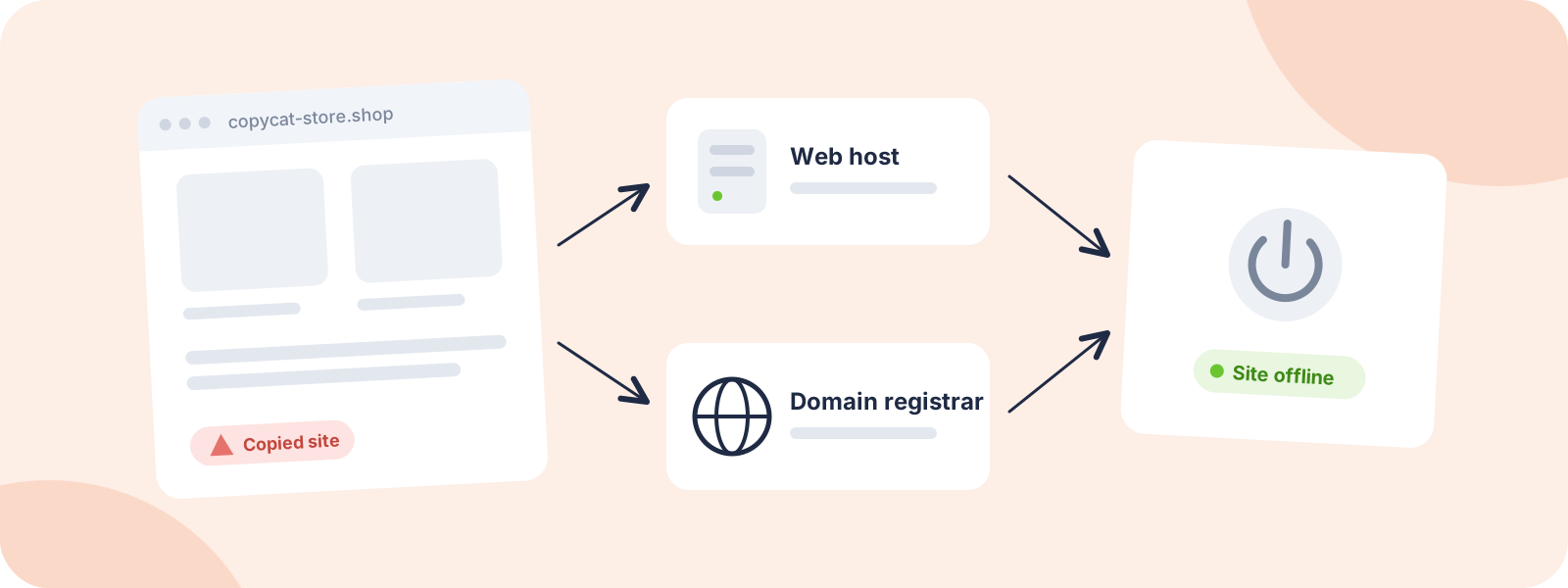
When can a whole website be taken down?
Most takedowns remove a page, a photo or a post. Taking down an entire site is a bigger ask, and the companies that can do it, mainly hosts, need a good reason. Common ones are:
- The site is built on your stolen content, like a copy of your whole website, or a site full of your photos, videos or articles.
- The site copies many people's work, like a piracy site, and keeps ignoring takedown notices.
- The site sells counterfeits using your brand name, logo or product photos.
- The site pretends to be your business to trick customers into paying or handing over login or card details.
If only one or two pages use your content, you don't need the whole site gone. Follow our guide on getting stolen content removed from a website instead. It's faster.
Only need the copyright basics? Our FAQ How do I get a website taken down? covers them.
Sites that post negative reviews, criticism or opinions you disagree with usually can't be taken down through these routes. False and damaging claims are a defamation matter for a lawyer.
Who can take a website down
Four companies have a say, and each can do something different:
- The site owner can remove the content, but sites built on stolen content rarely do it willingly.
- The hosting company runs the server the site lives on. It's usually the one that can take a whole site offline, and it decides based on its own policies and the evidence in front of it.
- The domain registrar sold the domain name. It can suspend the domain so the site stops loading, but it mostly acts on fraud, phishing and malware rather than copyright alone.
- Search engines can't take a site offline, but they can remove its pages from results, so far fewer people ever find it.
Working out which host and registrar a site really uses is where many cases stall. Sites that want to avoid complaints often hide their host, for example behind Cloudflare. See sites that use Cloudflare.
What a strong case looks like
Hosts don't take whole sites down on a hunch. They need to see that the site is built on infringement, not that it has one copied page. A strong case usually shows:
- Every infringing page, each matched to your original.
- Dated screenshots of the site.
- Proof that your content came first.
- A record of earlier notices the site ignored.
Putting that together for dozens or hundreds of pages is the slow part, and it's where most people get stuck.
If someone copied your entire website
Finding your whole website, with your words, photos and design, running on someone else's domain is one of the most common reasons a whole site can come down.
Signs your site has been copied
- A sudden drop in search rankings or traffic with no obvious cause.
- Your own text turning up on another domain when you search a sentence from your site in quotes.
- Customers mentioning orders, emails or accounts you don't recognize.
- An unfamiliar domain showing up in your analytics.
Why people copy whole websites
- To steal search traffic. A copy can pick up visitors who were looking for you, and sometimes outranks the original.
- To run a fake store. Your products and photos with the scammer's checkout, so customers pay for orders that never arrive.
- To phish. A lookalike login or payment page to collect passwords or card details.
- To save effort. Someone wants a site like yours without building one.
If the copy takes payments or logins under your name, it's a scam. Start with scam and phishing sites.
Proving you're the original
Dated evidence that your site came first helps a host act. Older versions of your pages in the Internet Archive's Wayback Machine, your domain registration date, and dated files or invoices from when the site was built all count.
Protecting your search rankings
Google is usually good at working out which site is the original, but copies sometimes rank, especially on a domain with more history than yours. Don't rewrite your site to get away from the copy. You're the original, and changing your content makes that harder to prove. Getting the copied pages out of Google protects your rankings while the site itself is dealt with.
Want to make your site harder to copy next time? See how to protect your website from content theft.
Scam and phishing sites
If a site copies your business to take payments, steal logins or collect card details, treat it as fraud first and copyright second. Your customers are at risk, so speed matters most.
- Don't enter any real details on the copy to test it.
- Report it to the host and the registrar as fraud or phishing, with screenshots of the payment or login page.
- Report it to Google as a phishing or scam site. If Google confirms it, many browsers can warn visitors before the page loads.
- Warn your customers by email and on social media, and remind them of your real web address.
- If customers lost money, encourage them to contact their bank, and consider reporting it to the police.
Cutting off search traffic
Getting a whole site offline can take time. Getting its pages out of Google means far fewer people find it in the meantime, and it keeps a copy of your site from competing with you in search. Google only acts on requests that list the infringing pages precisely and show what was copied. See how removing a webpage from Google works.
Why whole-site takedowns are harder
- Hosts look harder. Taking a whole site offline is a bigger decision than removing one page, so hosts review these cases more carefully.
- Some sites pick hosts that ignore complaints, often in countries with weaker enforcement.
- Sites move. A site pushed off one host can reappear on another host or a new domain, and the case starts again there.
- Registrars rarely act on copyright alone, so they're no shortcut for a copied site.
- Notices go unanswered. Without follow-up, a whole-site case can stall for weeks.
If a site is causing serious harm to your business, a lawyer can tell you whether court orders are an option where you are. DMCA.com is not a law firm.
How long does it take?
Whole-site cases usually take longer than single-page removals, because hosts review them more carefully. In the cases our team handles, most come down within 24 to 48 hours, and the average is 5 to 10 business days. Rare cases can take a month or longer, especially with sites overseas or built to dodge requests. No one can honestly guarantee a time frame.
How DMCA.com can help
Prefer to hand it off? Here's how our team can take this on for you.
When you ask us to remove an entire site, list as many infringing URLs as you can, each matched to your original page. Our team builds the case, notifies the site and host, and keeps following up.
- Standard takedowns start at $199 per site, with a money-back guarantee on qualifying cases
- Sites with many infringing links or hosts that ignore notices are covered by our Premium Takedown ($399 per site). Google search removal and legal escalation are part of Platinum ($599 per site)
- A real person reviews your case and tells you which option fits before you pay anything extra
- Prefer to do it yourself? Protection Pro ($10 a month) includes the DIY Takedown Toolkit: notice templates and host lookup tools
Common questions
A competitor copied my website design. Can I take their site down?
If they copied your actual text, images or code, those can be reported. A similar layout, color scheme or idea on its own is much harder to act on.
Will a copy of my website hurt my Google rankings?
It can. Google usually identifies the original, but a copy can sometimes compete with you or outrank you. Getting the copy removed, and getting its pages out of Google, protects your rankings.
Should I rewrite my content so it's different from the copy?
No. You're the original, and keeping your content as it is helps prove that. Focus on getting the copy removed instead.
The copy is using my business name to take orders. What should I do first?
Treat it as fraud. Report it to the host, the registrar and Google as a scam site, warn your customers, and then deal with the copyright side.
Who decides whether a website comes down?
Mostly the hosting company, which can suspend the site, and sometimes the domain registrar, which can suspend the domain name. Each makes its own decision based on its policies and the evidence it's given.
Will the site owner find out who reported them?
Possibly. Hosts often pass copyright notices on to their customer. Use a business email address if privacy matters.
Can a website come back after it's taken down?
Yes. Some owners move to a new host or a new domain, so whole-site cases often need follow-up after the first removal.
Can you legally take down a website?
Yes, through the proper channels, like formal takedown notices and removal from search results. Trying to knock a site offline by hacking or flooding it is illegal, even if the site stole from you.
More quick answers in our FAQ: I found a negative review of me online and Will a DMCA takedown work in other countries?
JL
About the author
Julie Lyle is the Takedown Manager at DMCA.com, where she oversees professionally managed takedown cases, from copyright removals to Google search removals. More about Julie