Guides › Copyright basics
Guide
Trademark vs copyright: which one gets your content taken down?
Filing the wrong kind of report is one of the most common reasons a takedown goes nowhere. Copyright protects what you create. Trademark protects your brand. Here's how to tell which one you're dealing with, and what to file.
By Julie Lyle, Takedown Manager at DMCA.comUpdated October 21, 20265 min read
The difference in one minute
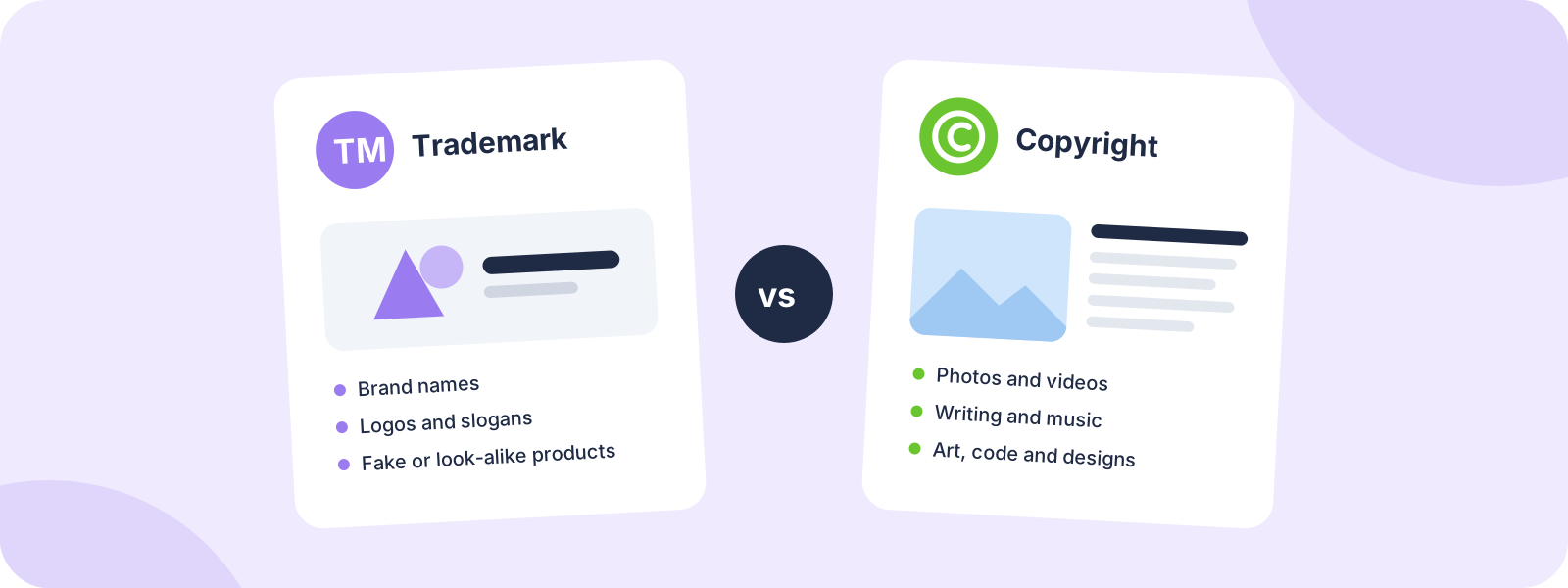
Copyright is about creative work. The moment you take a photo, write a post, record a video or design a graphic, you own the copyright in it. Someone copying that work without permission is copyright infringement.
Trademark is about identity in business. Your brand name, logo and slogan tell customers who's behind a product or service. Someone using them in a way that confuses customers, like selling fakes or pretending to be you, is trademark infringement.
The quick test: did they copy something you made, or something that identifies you? Made is copyright. Identifies is trademark.
This guide is general information, not legal advice. DMCA.com is not a law firm.
Side by side
- What it protects. Copyright: original creative work. Trademark: names, logos, slogans and other brand identifiers.
- When you get it. Copyright: automatically, as soon as the work exists. Trademark: by using the mark in business, with stronger rights if you register it.
- Registration. Neither is required to report a problem. Registration helps if you ever go to court.
- What counts as misuse. Copyright: copying, posting or sharing your work without permission. Trademark: using your brand in a way likely to confuse customers.
- How to report it online. Copyright: a DMCA takedown notice or a platform's copyright form. Trademark: a platform's trademark or brand report form.
Which one is your problem?
Usually copyright
- Someone reposted your photos, videos, artwork or music.
- A site copied your blog posts, product descriptions or course content.
- A store is using your product photos to sell its own items.
- Someone cloned your whole website. See what to do if your website was copied.
Usually trademark
- Someone is selling fake versions of your product under your brand name.
- An account or page is pretending to be your business.
- A competitor uses a name or logo so close to yours that customers mix you up.
- Someone registered a domain name with your brand in it to mislead people.
Neither
- Someone used the same idea, style or concept as you, but made their own version. Copyright covers how something is expressed, not the idea.
- False or harmful claims about you. That's defamation, which needs a different route.
- Your personal information posted online. That's a privacy issue. See removing personal info from Google.
When it's both
A lot of real cases mix the two. A fake online store might use your brand name and logo (trademark) along with your product photos and descriptions (copyright). A logo can be both: the artwork is protected by copyright, and its use as your brand is protected by trademark.
When that happens, file both kinds of report. The copyright takedown often moves faster because it's easier to prove: here's my original, here's the copy.
How to report each one
Copyright
- Copyright complaints go to whoever controls the content: the website owner, the company hosting the site, or the platform it's posted on. Our FAQ on how to file a DMCA takedown notice explains what a notice is and what it has to include.
- Big platforms review copyright complaints through their own teams, and each one asks for slightly different details.
- Search engines can also remove a copied page from results, separately from the site itself.
Trademark
- Platforms handle trademark and brand complaints separately from copyright, usually through their intellectual property teams.
- Impersonation is usually handled as its own type of report.
- For a domain name built on your brand, there's a separate domain dispute process. That usually needs a lawyer.
Where people get stuck
- Filing the wrong type. A copyright complaint about a brand name, or a trademark complaint about a photo, usually gets rejected.
- Finding the right contact. Copycat sites often hide who runs and hosts them.
- Getting every detail right. Missing URLs or proof of ownership are the most common reasons a complaint is turned down.
- Following up. Many sites ignore the first notice.
How DMCA.com can help
Prefer to hand it off? Here's how our team can take this on for you.
If your work has been copied, including product photos, website text or videos used by a fake store or a copycat, we handle the copyright takedown for you. If your brand is being misused too, we handle that as well.
- Trademark enforcement takedowns and cease and desist notices are part of our Platinum Takedown ($599 per site)
- We draft the notice, find the right contact and send it
- Standard takedowns are $199 per site, with a money-back guarantee on qualifying cases
- Sites that ignore notices are covered by our Premium Takedown ($399 per site), and Google search removal is part of our Platinum Takedown ($599 per site)
- Rather send copyright notices yourself? Protection Pro ($10 a month) includes the DIY Takedown Toolkit: notice templates and host lookup tools
Common questions
Can I use a DMCA notice for trademark problems?
No. A DMCA notice only covers copyright. For brand names, logos and impersonation, use the platform's trademark or impersonation report.
Is my logo protected by copyright or trademark?
Often both. The logo artwork can be protected by copyright, and its use as your brand is protected by trademark.
Do I need to register my copyright or trademark to report misuse?
No. You can report either one without registering. Registration matters more if you go to court.
Someone copied my business name. Is that copyright?
No. Names, titles and short phrases aren't protected by copyright. If the name is your brand, that's a trademark issue.
A fake store is using my product photos. What do I file?
A copyright takedown for the photos, since you created them. If they're also using your brand name or logo, file a trademark report as well.
JL
About the author
Julie Lyle is the Takedown Manager at DMCA.com, where she oversees professionally managed takedown cases, from copyright removals to Google search removals. More about Julie
Has someone copied your work or your brand?
Send us the links. A real person on our team checks your case and handles the takedown, copyright or trademark, from start to finish.