Before you use a template
- Make sure it's a copyright problem. Templates are for copied photos, videos, writing, music, art and code. Brand names and logos are trademark. See trademark vs copyright.
- Think about fair use. Commentary, criticism and parody can be allowed without permission. See is it fair use?
- Find the right contact. Our FAQ on how to file a DMCA takedown notice explains who receives a notice and what happens next.
Only send a notice for work you own, or are authorized to act for. Under US law, knowingly making a false claim in a takedown notice can make you liable for the damage it causes.
What a notice must include
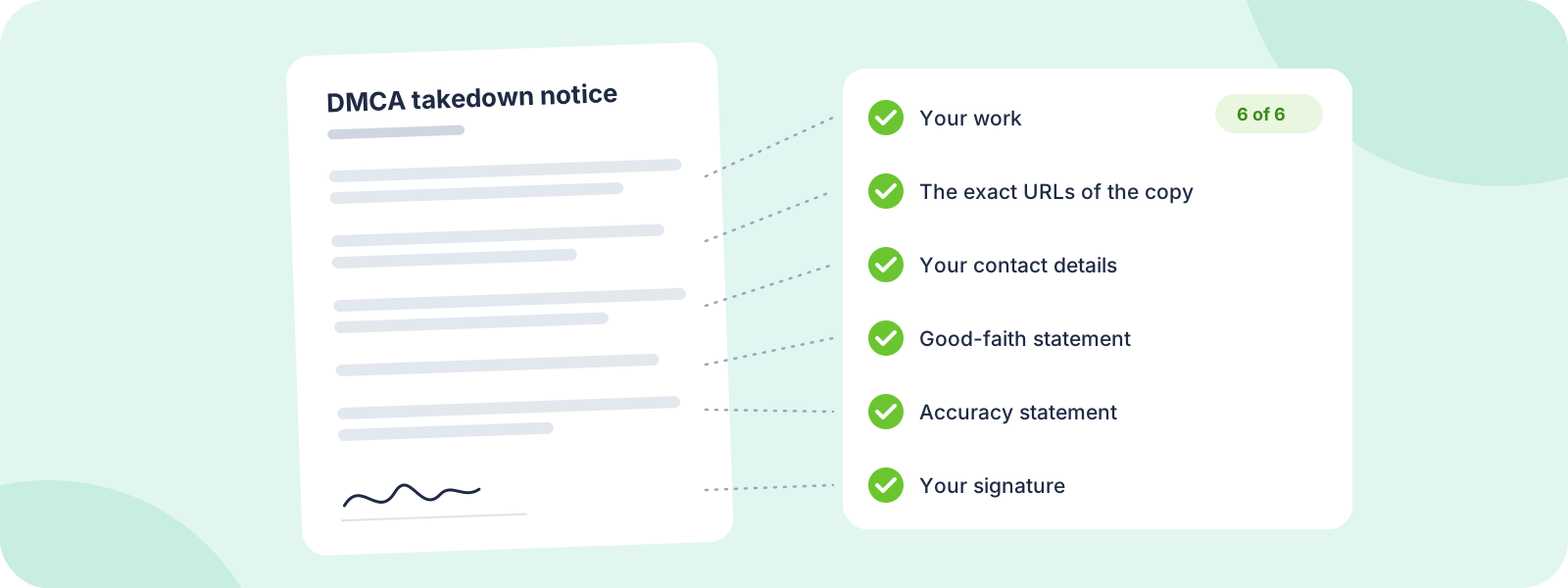
Every DMCA takedown notice, whether it's built from a template or written from scratch, needs these six things:
- Your signature, physical or electronic
- The work that was copied
- The exact location of each copy
- Your contact details
- A statement that you believe in good faith the use isn't allowed
- A statement, under penalty of perjury, that the notice is accurate and that you own the work or can act for the owner
Getting every detail right for the site you're sending it to is where most people get stuck. The DIY Takedown Toolkit in Protection Pro ($10 a month) has ready-made notice templates that cover all six, or our team can write and send the notice for you from $199 per site.
What each part does
- Your work and the original link show the site what was copied and that it's yours.
- The exact URLs tell the site precisely what to remove. Vague locations are the most common reason notices stall.
- The good-faith statement says you believe the use isn't allowed.
- The accuracy statement confirms, under penalty of perjury, that you own the work or can act for the owner.
- Your signature and contact details let the site reach you. Typing your full name counts as a signature.
Leave out any of these and a US site can treat the notice as incomplete.
Other versions you may need
A basic notice to a website's copyright contact fits many cases. Some situations need different wording:
To a hosting company
When a site ignores notices, has no contact details or hides behind a service like Cloudflare, the notice often has to go to someone else, such as the company hosting the site. Working out who that is, and wording the notice for them, is where a lot of cases stall. See filing a notice when a site uses Cloudflare.
For a business or client
If you're filing for a company or someone else, the notice has to say who owns the work and that you're authorized to act for them, and it's signed with your role and company name.
Follow-ups
Many notices need at least one follow-up before anything happens. Knowing when to follow up, and who to escalate to when a site goes quiet, is a big part of getting content removed.
European sites
Sites in the EU follow EU rules, not the DMCA. A notice written for those rules drops the US "penalty of perjury" wording and explains why the content is unlawful. See takedowns in Europe.
Canada
Canada uses a "notice and notice" system, where hosts forward your notice to the uploader instead of removing the content. The notice is worded differently.
Need one of these? The DIY Takedown Toolkit in Protection Pro ($10 a month) generates complete personal and business notices for the US, Canada, the EU (including the UK) and India from your case details, ready to download as a PDF.
How DMCA.com can help
Two ways to get it done: send it yourself with our templates, or have our team handle it.
Generate notices automatically
Protection Pro ($10 a month) includes the DIY Takedown Toolkit: notice templates and host lookup tools. Enter your case details, pick a personal or business notice for your country, and download it as a PDF.
Have us do it for you
- We draft the notice, find the right contact and send it
- We follow up with the site and the host until it's handled
- Standard takedowns are $199 per site, with a money-back guarantee on qualifying cases
- Sites that ignore notices are covered by our Premium Takedown ($399 per site), and Google search removal is part of our Platinum Takedown ($599 per site)
Common questions
Where can I get a DMCA notice template?
Protection Pro ($10 a month) includes the DIY Takedown Toolkit, with personal and business notice templates for the US, Canada, the EU (including the UK) and India. Or our team can write and send the notice for you, with managed takedowns from $199 per site.
Do I have to sign a DMCA notice?
Yes. A notice needs a physical or electronic signature. For email or an online form, typing your full name is the usual way to sign.
Can I send one notice to several websites?
No. Each website or host needs its own notice. You can list several URLs from the same site in one notice.
Do I need a lawyer to send a takedown notice?
A takedown notice isn't a lawsuit, so most people don't start with a lawyer. Many use a takedown service, which writes the notice, finds the right contact and follows up. A lawyer becomes useful if the case could go to court. DMCA.com is not a law firm and doesn't give legal advice.
Will a DMCA notice work outside the US?
Often, yes. Many platforms and hosts around the world accept DMCA notices. Sites in the EU follow EU rules, and Canada uses a notice and notice system, so the wording changes there.
What if the site has a copyright form?
Then the report usually goes through the form, not email. It asks for the same information as a notice, in its own format, and a report with a missing or mismatched detail can be rejected.
JL
About the author
Julie Lyle is the Takedown Manager at DMCA.com, where she oversees professionally managed takedown cases, from copyright removals to Google search removals. More about Julie